
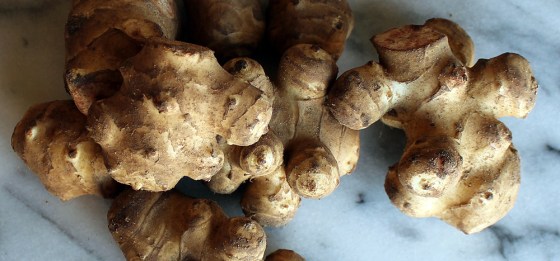
The Mariquita Farms “Mystery Boxes” (actually, they’re really big bags) we buy twice a month are always filled with beautiful, in-season veggies in an extraordinary variety. The fun of the mystery is that you really don’t know what you’re going to get before you show up to grab the bag off the back of the farm’s delivery truck. And from time to time, we get something that we’ve never considered buying but have always been curious to try.
Such was the case with a recent bag that included a lot of Jerusalem Artichokes. We’ve seen them around. They’re knobby little tubers that look sort of like ginger root or galangal, have the texture of apple or Jíca
ma when raw and make for a delicious puree when boiled like a potato. Cooked, they have an earthier, sweeter flavor than potato, which is to say you get more of the mineral flavor of the soil they’re grown in. They aren’t a starchy veggie, so you don’t get the same fluffy, dry mouth feel you get from potato. Instead, they’re a bit waxy when cooked through. Eaten raw, they’re crisp and a little sweet thanks to their high fructose content. They’re delicious as an addition to your dinner salad.
Nobody knows how the plant got its name. This member of the sunflower family (hence the alternative name ‘sunchoke’ or ‘sun choke’) isn’t an artichoke, and it doesn’t come from the Middle East (it’s a North American native species). Aboriginal North Americans were cultivating and eating it when the first Europeans landed on our shores. It made its way to Europe in the early 1600’s and was quickly adopted on the continent. That’s about all we know about its earliest culinary uses. The bulbs are loaded with potassium and iron and they’re low carb/low glycemic diet-friendly thanks to their high inulin content.
We adapted a bon appétit recipe for Fried Sunchoke Chips with Rosemary Salt by toasting thin slices of Jerusalem Artichoke in the oven on an oiled sheet pan before sprinkling them with the herbaceous salt. We recommend getting them as thin as possible so that they dry as they brown. Our first go at oven roasting produced a softer chip because of the thickness of the slices, but they were sweet and delici
ous all the same.
Oven Roasted Jerusalem Artichoke Chips sprinkled with Rosemary Salt
1 lemon
1 tablespoon kosher salt
1 tablespoon finely chopped fresh rosemary
1 pound Jerusalem artichokes
3 tablespoons olive oil
Preheat the oven to 350 degrees and line two baking sheets with aluminum foil. Mix the salt and rosemary together in a small bowl, set aside. Cut the lemon in half and squeeze one half of it in a bowl filled with fresh water. Scrub the Jerusalem artichokes until very clean; place them in the bowl of acidulated water. Thinly slice each tuber, about 1/8 to 1/16 inch thick, or as thin as possible. Empty the water from the bowl and dry. Add the sliced tubers to the bowl and squeeze the other half of lemon over the top. Add the olive oil and toss to coat. Evenly place the slices on the baking sheets in one layer, do not over lap. Lightly sprinkle the rosemary salt over the slices and place in the oven. Bake for 15 minutes; then pull the pans out of the oven and begin to remove the browned and crispy ones from the pan. Rotate the pans and place them back in the over for 3-5 minutes. Continue to check the tuber slices and remove the crispier ones and place the lighter colored ones back in the oven. This will take up to 30-40 minutes. Consolidate the slices to one pan when there is room available. Sprinkle more rosemary salt over the top. Serve warm or at room temperature.


 (y)our food choices™