We love to eat in restaurants. Who doesn’t? A staff of people prepare, serve and clean up all while you move from course to course savoring things you’d prefer not to try making at home. But whether we eat out to celebrate a special occasion or stop for quick take-out because we’re too spent to cook after work, there are a few things we try to keep in mind when picking a restaurant. What follows is our working list of tips for saving a little money while taking it easy on the environment whenever eating out.
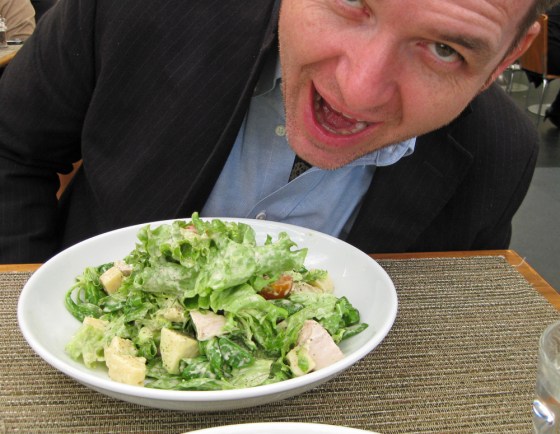
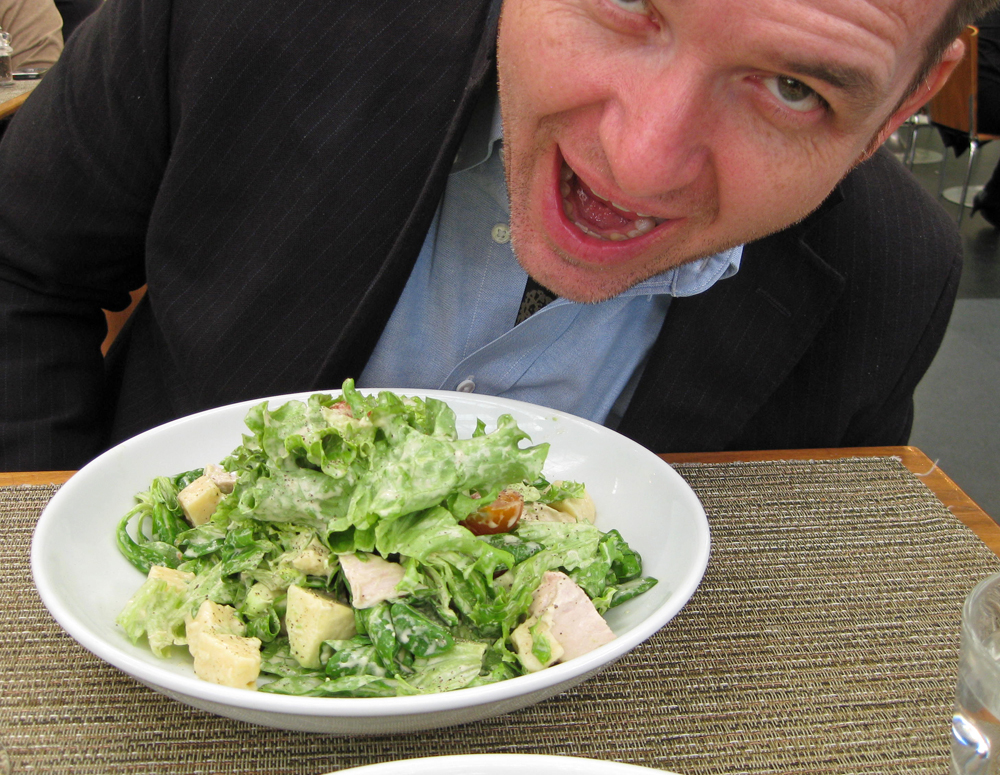
Steve loves to eat his greens, but he still has troubles using a fork.
1. Know why your eating.
Are you going out for a celebratory meal or are you heading to your favorite comfort food spot to fill a void? Maybe you’ve finished a big project at work or at home and a reward is in order. Or maybe you just can’t face the leftovers sitting at home in the fridge. Think about the reasons you’re going out to eat before deciding where and what you’re going to eat. If the next meal out is for a celebration, plan ahead by cutting back a few weeks before or put a little aside in savings before the big meal. If you’re ducking into a restaurant just because you’re hungry and it’s a typical weekday look for early bird specials on line, a few minutes on the computer could save you a lot of money before you step into the restaurant. Familiarize yourself with the menu and know what things cost.
2. Just say “No” to Super Size.
Deciding which types of foods you’re going to avoid before you walk through the doors will make it easier at the check out register to avoid the impulse items like chips, fries, desert, ice cream, soda, etc. Decide what can be eliminated from the total bill before you order. Do you really need a soda? Why not tap water instead? Does the meal come with sides or are they extra? Maybe you can order two sides instead of an entrée for your meal. Watch your portions and avoid the fillers. You’ll save money and you’ll do your body a favor.
3. Don’t eat at the chains.
You can eat the same soup, burger, pasta, etc. at any number of chain restaurants throughout the country, but why limit yourself to so few generic choices? Why settle for the mundane when you can have something completely unique and original by dining in local businesses. Most chains get all their produce from the same location and it’s shipped to that particular restaurant from central distribution points somewhere hundreds or thousands of miles away. Almost nothing is local and nothing is fresh. In fact, most chain restaurants depend heavily on processed foods that are manufactured in a centrally located factory and then shipped to multiple locations throughout the country. That’s not cooking, that’s factory-style assembly line manufacturing and the product is not what we would call food. Try the little locally owned bistro or café down the street, or, for a quick bite, try the taco truck that all the construction guys line up for at lunch time. Helping out your neighbors instead of underwriting the enormous bonuses of the CEOs of the major food conglomerates is the right way to contribute to our local economies and it may help get us out of the recession we are in. Plus, eating locally actually helps expand your food choices.
4. BYOW (Bring Your Own Wine)
Sure, you’re going to be paying a corkage fee of anywhere from $10-$20 for the bottle of wine plus the cost of the wine itself, but if you bring in an inexpensive wine (not to be confused with cheap wine) it will cost less than buying a bottle from the restaurant’s wine list. Restaurants make the bulk of their profits from wine and liquor sales, not from the food they serve. A $40 bottle of wine in a restaurant will cost about $10 in a grocery store. Add the most expensive corkage fee and you’re still saving $10.
Note: never bring in a bottle of wine that the restaurant has on its wine list. It’s just considered bad manners.
5. BYOC (Bring your own [to-go] containers)
This one is easier said than done, but with proper planning you can stop adding unnecessary garbage to the local landfill by bringing reusable storage containers with you to the restaurant. This is also a great trick to use if you’re looking to lose weight. Once your plate arrives, box up half the meal and put it away so you’re not tempted to eat the whole meal, cutting your calories for the meal in half. You can also ask the waiter if the kitchen wouldn’t mind pre-boxing the meal before the plate arrives. You not only save yourself from temptation, you save money by turning the extra into another meal. By bringing your own to-go containers, you also reduce the amount of waste produced by the restaurant.
6. Eat early or Eat late.
Two words–Happy Hour! Many restaurants are luring people in with double happy hours, usually Monday-Friday an hour earlier than most people get off work, and some places even have a second happy hour in their last hour of business. Smart phone apps like Happy Hour will give you the low down on where to go and what to eat. Remember though that happy hour cocktails are usually made with well (cheap) alcohol, the wine will be the cheapest ones on the menus and the food could be fried. If you plan to stray from the happy hour menu be prepared to pay full price.
If you want a slightly healthier happy hour try a sushi restaurant.
7. Drink your cocktails in a bar, or at home, not at a restaurant.
Once alcohol hits your system, your inhibitions are reduced causing you to relax and enjoy yourself. Which isn’t a bad thing, right? Wrong. With lower inhibitions you’re more likely to order that appetizer, salad, and dessert, along with another cocktail or two, increasing your tab substantially. That $20 meal out is now $80, and the $5 tip is now $15. Congratulations, that cocktail just cost you $100.
If you do want to drink, select a beer or an inexpensive glass of wine. The beer will help fill you up so you don’t want to eat or drink as much. The wine you can sip and still feel more in control than you would with pure alcohol hitting your empty stomach.
Keeping your drinking to a minimum will help lower the size of your tab along with helping you control your waist size. Remember, everything in moderation.
8. Nothing wrong with a coupon.
There are so many on-line coupons these days there’s really no reason not to use one on your next dinning experience. Blackboard Eats and Scoutmob are two of our favorite’s because we don’t pay for the coupon, it’s free or, in the case of Blackboard Eats, a minimal expense at $1 a coupon or $20 annually. Others like Groupon, Yelp Deals, and Three Knocks have daily deals where you pay a certain amount for a gift certificate worth usually twice as much as you paid. If you’re going with one of these pre-paid coupons make sure you remember you have the coupon and use it before it expires. However, our money is on the free coupons. Our personal thoughts, “Why pay for something we can get for free?”
Added note on coupons: When making a reservation use Opentable.
Opentable rewards its users with gift cards worth money off their next meal out. Even if you’re heading out the door you can still make your reservation using your smart phone app. After 2000 points you can redeem an award for a $20 coupon, 5000 points, $50, and so on. Just by being prepared you get rewarded. Cost to you: nothing.
9. Be French, have a large lunch instead of going out for dinner.
Many restaurants have separate lunch and dinner menus but almost all of them have the same things on both menus. The catch is that dinner menus are more expensive. It’s always less expensive to eat out for lunch instead of dinner, it’s what the French do. They’ll go out and spend an hour or two on a fabulous, and large, lunch. Then, when dinnertime arrives, it’s a very small nosh. Maybe it’s time that Americans take a clue from the French and enjoy the afternoon a little more, bring a nice bottle of wine and your lunch will be just as delicious as your dinner would have been, but you won’t go to bed feeling bloated and regretting the dessert you had. It will also give you plenty of time to work off that piece of cheesecake before turning in for the night.
10. Don’t be cheap, Tip! (but only on the meal, not the taxes)
Just because you’re trying to save some green it doesn’t mean you have to be cheap with your server. Personally, we believe gratuity should automatically be included in a bill as the French do it. But since we live in America, we don’t see it happening anytime soon. Gratuity should be 10% for poor service, 15% for average service, and 20% for extra ordinary service. The tip should be on the food and beverage cost only, no need to include an extra generous tip based on the sales tax and any other state and local fees.
Most servers also split their tips with many other people you may or may not see; bussers, bartenders, expediters, dishwashers and others may get a percentage based on the server’s sales. Also, the IRS knows that servers live off of tips and require that they claim a percentage of their sales as taxable income. Some restaurants even have a mandatory percentage that they will claim for the server to avoid being audited.
Bottom line, this is one area you should not skimp on. If you can’t afford to tip you shouldn’t eat out in a restaurant.
11. Eat Vegetarian.
Almost all restaurants offer vegetarian options which are usually less expensive than meat dishes. This is not only healthier but also reduces greenhouse gases emitted by factory farms. Plus, in some restaurants, it’s difficult to know where they are sourcing the meat and fish. Even at the so-called greener restaurants it’s difficult for them to know if every piece of meat is coming from a sustainable source. You can always ask your server, but if it’s in the middle of the dinner rush they may not have all the answers or be able to find them out for you.
At least by sticking with vegetables and grains you’ll feel less full and won’t feel guilty for eating the molten lava cake.
With this weekend being one of the busiest for all restaurants we hope everyone has a wonderful dining experience. Relax, and remember, sometimes it’s not about the food but the company. Enjoy yourself and the people you dine with.
Cheers,
Jason and Steve








 (y)our food choices™