Ah, those crazy Brits with their oddball named desserts. Spotted Dick is not a genital disease as one might imagine, but an English “pudding” made of suet, raw beef or mutton fat. And while we were in London we did our best to find, er, spot a Spotted Dick. We found it on a couple of menus but just couldn’t bring ourselves to actually order the pudding without a childish snicker. We felt like it would be inappropriate to order it from a female server and even with a male waiter we just couldn’t bring ourselves to actually say it to him, gay or straight. I mean, come on, how do you ask someone for a spotted dick without blushing and giggling? You just can’t.
Maybe it was something in the air in Paris that gave us the nerve to order a brioche spotted dick, or, maybe it was because I made Steve go into the lovely little Marais shop without me. Either way, we tasted our first spotted dick from a Paris patisserie, but it wasn’t the traditional English dessert. This was a chocolate chip brioche in the shape of a penis. A few blocks away from our vacation rental was a cute little boulanger and patisserie called Legay Choc. Legay is the last name of the two brothers who own the bakery, and as chance would have it, one of them is, in fact, gay. The shop is filled with delicious pastries, breads, and sandwiches, but the thing that brings customers, and oglers, into their shop is their brioche “Spotted Dicks.” As you step in, you’re welcomed with a basket full of the phallic chocolate chip wonders. They look so tempting, who could resist such a playful temptation? These fat tasty loaves aren’t just a gimmick, the brioche holds its own against the best boulangeries in Paris, and San Francisco. After each of us pulled off a “testicle” and tasted it for ourselves we can attest to the sweet, lip-smacking tenderness of these chewy morsels. Needless to say, we thoroughly enjoyed each and every bite, and it left us wanting more.
Now that we’re back in the US we’re on a quest to make the British version of Spotted Dick. The challenge we face is finding suet. We need a very small amount of this exotic fat for the recipe. Who really needs five pounds of beef fat in their freezer when the recipe only asks for 3.75 ounces? Five pounds of extra is a lot of beef fat for Spotted Dick. We know there are recipes out there that substitute butter for suet, but in our opinion, that’s just cheating. If you can find suet at your local butcher shop we suggest you give it a try. And, if you know of a butcher shop in San Francisco that sells suet in small amounts let us know. We’d really like to give the authentic recipe a try.
So we decided to go for the Parisian version of Spotted dick a la Lagay Choc. It does call for a lot of butter, but at least we can find good butter easily. The brioche recipe is Nancy Silverston’s from the cookbook, Baking with Julia, with the addition of chocolate chips. Nancy, we hope you’re not offended that we use your brioche recipe, we just think it’s the best.
Yes, it’s juvenile, and yes, it is gay, but that describes us–gay and juvenile. If you can’t afford a trip to Europe and you’re hankering for a spotted dick without a visit to the doctor for a shot of penicillin, try one of these two recipes. It might end up being your favorite dessert or, at the very least, might add a little spice to your sweet tooth life. And, as it’s done for us, may arouse your baking appetite.
Enjoy!
Spotted Dick – British Version
[Adapted from epicurious.com]
The long sausage shape has been changed and instead calls for a pudding mold, so this version is acceptable to serve in mixed company and with children. Just don’t tell them the real name of the dessert, unless you want snickers and giggles throughout dessert.
1 1/2 cups all-purpose flour
1/3 cup sugar
1 tablespoon baking powder
3/4 teaspoon salt
1 cup cold finely chopped rendered beef suet (4 oz)
8 tablespoons whole milk
1/2 cup mixed currants and golden raisins or other assorted dried fruit
1/2 teaspoon finely grated fresh lemon zest
Custard Sauce (your favorite version)
Fill a large heavy pot (at least 8 inches across by 6 inches deep, with a tight-fitting lid) with 1 1/2 inches water. Make a platform for pudding by setting metal cookie cutters or egg-poaching rings in bottom of pot.
Pulse together flour, sugar, baking powder, and salt in a food processor. Add suet and pulse until mixture resembles coarse meal. Transfer mixture to a bowl. Drizzle evenly with milk and stir with a fork until incorporated. Knead fruit and zest into dough until a slightly sticky and form into a ball. Put into well-buttered pudding mold and flatten top. Top dough with a round of buttered wax paper, buttered side down, and cover top of mold with heavy-duty foil, crimping tightly around edge.
Bring water in pot to a boil and set mold on platform. Steam pudding, covered, over simmering water 1 1/2 to 2 hours (add more boiling water to pot if necessary), or until golden and puffed. Transfer pudding in mold to a rack and let stand 5 minutes. Discard foil and wax paper and run a thin knife around edge of pudding. Invert a plate over mold, then invert pudding onto plate.
Serve immediately with your favorite custard sauce.

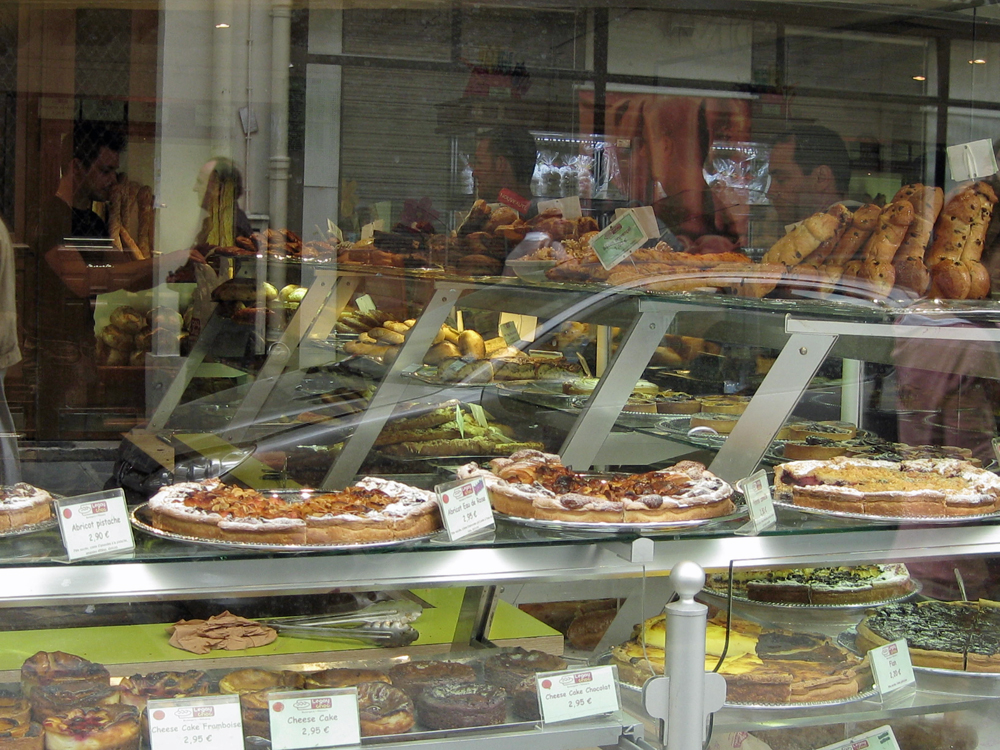
A view into Legay Choc. To the right you’ll see a tray full of spotted dicks.
Spotted Dick – Parisian Version a la LaGay Choc
Note: This is chef and baker Nancy Silverton’s brioche recipe as it appears in the book Baking with Julia. All credit to Chef Silverton for the recipe that follows, with the exception of the addition of chocolate chips and the shaping of the loaves. The accompanying photographs are all ours.
Brioche Recipe
The Sponge
1/3 cup warm whole milk (100°F to 110°F)
2¼ teaspoons active dry yeast
1 large egg
2 cups unbleached all-purpose flour
Put milk, yeast, egg, and 1 cup of flour in bowl of heavy-duty mixer. Mix ingredients together with spatula or spoon until blended. Sprinkle remaining cup of flour over sponge to cover. Set sponge aside to rest uncovered for 30 to 40 minutes. The flour coating should start to crack by the end of the resting time. This is a good sign things are going as they should.
The Dough
1/3 cup sugar
1 tsp kosher salt
4 large eggs, lightly beaten
1 ½ cups (approximate) unbleached all-purpose flour
1 ½ sticks (6 oz.) unsalted butter, at room temperature [Note: ALWAYS use unsalted butter!]
¾ cup chocolate chips (optional)
1 egg beaten with 1 tablespoon cold water, for egg wash
Add sugar, salt, eggs and 1 cup of flour to the sponge. Attach bowl to mixer and, using the dough hook, mix on low for a minute or two, just until the ingredients look like they’re coming together. With the mixer on, sprinkle in ½ cup more flour. When the flour is incorporated, increase the mixer speed to medium and beat for about 15 minutes, stopping to scrape down the hood and bowl as needed. During the mixing period, the dough should come together, wrap itself around the hook, and slap the sides of the bowl. If, after 7 to 10 minutes, you don’t have a cohesive, slapping dough, add up to 3 tablespoons more flour. Continue to beat, giving the dough a full 15 minutes in the mixer. Long mixing gives the brioche its fine texture.
Incorporating the Butter
In order to incorporate the butter into the dough, you must work the butter until it is the same consistency as the dough. According to Julia, “you can bash the butter into submission with a rolling pin or give it kinder and gentler handling by using a dough scraper to smear it bit by bit across a smooth work surface.” (Can’t you just see her whacking away at a lump of cold butter with her rolling pin?) When it’s ready, the butter will be smooth, soft, and still cool. It should not be warm, oily, or greasy. Add the softened butter, a few tablespoons at a time, to the dough with the mixer on medium-low. If the dough looks like it’s falling apart, don’t worry about it. It’s supposed to. Once all the butter is incorporated, raise mixer speed to medium-high for a minute, then reduce the speed to medium and beat the dough for about 5 minutes. The dough should begin to make a slapping sound again as it comes together. If the dough isn’t coming together after a couple of minutes, add up to one more tablespoon of flour. When finished, the dough should be cool, soft and a little sticky.
First Rise
Transfer the dough to a very large buttered bowl, cover tightly with plastic wrap, and let it rise at room temperature until doubled in bulk, 2 to 2 ½ hours.
Second Rise
Deflate the dough by placing your fingers under it, lifting a section of dough, and then letting it fall back into the bowl. Work your way around the circumference of the dough, lifting and releasing. Cover the bowl tightly with plastic wrap and refrigerate the dough overnight, or for at least 4 to 6 hours, during which time it will continue to rise and may double in size again. After chilling, the dough is ready for use.
Shaping the loaves (4 small loaves or 2 large ones)
Line two cookie sheets with parchment paper. If you’re using chocolate chips knead them into the cool dough before shaping. Divide the dough into two, or four equal parts. With each part separate so there are two smaller “balls” and one larger piece of dough. Roll larger dough into a sausage shape and place the two smaller balls on each side, like a penis. Place on the parchment paper leaving enough space for each penis loaf to rise with touching. Repeat with remaining dough.
Final Rise
Cover the pans with buttered wax paper (or plastic wrap) and a kitchen towel. Allow to rise at room temperature for about 2 hours, or until doubled in size.
Baking
Preheat the oven to 375 degrees. Lightly brush the brioche loaves with egg wash, careful not to drip the wash on the parchment paper. Bake the brioche loaves for about 30 minutes, or until they are golden brown. If the loaves are browning too quickly cover them loosely with a piece of aluminum foil, tented. Cool to room temperature on a rack.








 (y)our food choices™