Persimmons

Persimmon 2

Fuyu Persimmon

About a year ago, one of my colleagues sent an email to the office asking if anyone wanted a couple of Fuyu persimmons. He’d received them in his weekly CSA box and neither he nor his wife knew what to do with them. Most of the folks in the office were likewise unfamiliar with the fruit and ignored the offer. But somebody who knew better snapped them up quickly and I was out of luck.

We haven’t been persimmon eaters for long. My first taste of a persimmon came as an amusing shock. Ever game to try something new, I picked an unripe persimmon from a tree in a Florida backyard and took a bite. The puckering, astringent juice of the still hard fruit was revolting and I spit it out the moment it hit my tongue. We don’t grow persimmons in Idaho so this bright orange fruit was an exotic the first time I saw one and I couldn’t resist the temptation to try it. It would be 20 years before I would step out onto that ledge again but mercifully the next taste was sweet and the exquisite fruit was nectar.

Persimmon 5

Muesli w/ Pineapple and Fuyu Persimmon

Persimmon ripeness is tricky to gauge. The temptation to cut into a piece of fruit that isn’t yet deep, dark orange should be resisted. Even if you’re eating a non-astringent Fuyu variety, you’ll be happier with the flavor if you wait for the firm flesh to ripen to the point of giving a little under pressure. Frustration with persimmons comes in two forms, however: waiting for unripe fruit to reach peak flavor in the first place and then realizing that you’ve let it get to be too ripe. The persimmon pucker is nasty but so too is the extreme sliminess of overripe fruit. Once ripe, they need to be eaten right away. They won’t “wait” for you to find a use for them.

Persimmon 4

Hachiya Persimmons

These beautiful Asian Hachiya persimmons have been cultivated in California for over a hundred years. They came from China via Japan, but today they are harvested nearby and arrive in our produce markets in October. The Hachiya is an astringent variety that has to ripen completely before it’s worth eating. Ripe, they are decadently sweet. The texture of the flesh is a little gelatinous. Some of the fruit can be a little fibrous. The flesh can be scooped out of the thick skin surrounding it. Just cut around the tough stem end to expose the inside of the fruit and scoop it out with a spoon. Serve persimmons at breakfast with yogurt and nuts or add them to your dinner salad. They’re amazing with cheese!

Edible varieties native to America grow in the eastern states. They’re much smaller than the Asian varieties at just an inch or so in diameter. Long a native food source, they aren’t commercially available except in the form of nursery grown trees. While you won’t find them in your local grocery, they’re commonly eaten where they grow.

We haven’t tried any of the thousands of persimmon pudding recipes out there, but we’re curious and look forward to giving it a try this fall. The fruit is incredibly versatile in its many uses as a moist binding agent in baked treats like cookies, cakes and quick breads. If you happen to be in Mitchell, Indiana (it could happen) next September, you’ll be able to hit the town’s Annual Persimmon Festival and check out the winners of the persimmon pudding recipe contest. We aren’t likely to make it, but we’re anxious to experiment with the persimmons we’ve picked up this year. We’ll be sure to bring updates on the results.

Cheers, Steve

The Egg

Bowl of Eggs

Beautiful Brown Eggs

“Tell me what you eat and I will tell you what you are.” – Jean Anthelme Brillat-Savarin

If we are what we eat, Jason and I are pretty egg-y guys.  Fresh eggs are a major staple in our meal repertoire. They show up on our plates in a number of forms. Not relegated to weekend breakfast, eggs are our go-to food morning, noon and night. They’re nutritious, economical and oh so versatile. They’ve taken their hits over the years from the anti-fat and cholesterol crowd, but reason seems to be returning to our understanding of these nutritionally dense, healthful wonders. Here are a few of our favorite egg meals.

Boiled

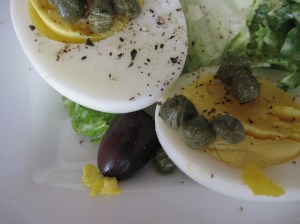
Boiled eggs can become a salad, a garnish for salad, a stuffing ingredient, a companion to diced avocado, or a simple snack on their own with a sprinkle of sea salt.

Boiled 2

Salade Niçoise

The best boiled eggs are cooked gently in water that is just hot enough to barely get to a simmer. Use a pin to puncture the “flatter” end of the egg and then ease it into the pan of hot water and leave it to cook for 10 to 12 minutes, depending on the size of the egg. Remove the pan from the heat and cool the egg under cold water. The gentle cooking method preserves the rich golden color of the yolk and prevents that green, sulfurous yolk coating from forming.

Poached

Poached 1

Dandelion Greens Salad w/ Poached Egg

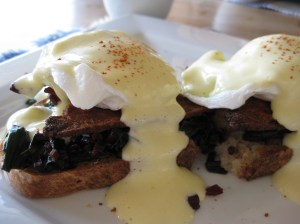
Poaching an egg creates an elegant, creamy platform for rich hollandaise. We love a poached egg on dandelion greens salad with crumbled bacon. And thanks to Lidia Bastianich, we’ve learned to poach them in simmering vegetable soups and served over toasted crusty bread. To get the best results in poaching, we create a hot “bath” of water in a pan that is deep enough for the eggs to sit under the surface. It helps to add a few tablespoons of distilled vinegar to the water. Doing so helps to arrest the dissolving of the egg white into the bath, firming them up into neat white packages. Use a slotted spoon to scoop them from the pan. Crack each egg into an individual bowl or ramekin and then ease them gently into the water one by one. Be sure to keep the egg from sticking to the bottom early in the poaching process or you’ll have a mess when you try to remove them. Poaching takes about 4 minutes. Once removed from their bath, the eggs should be rinsed in cool water to remove any vinegar flavor and to prevent the yolks from continuing to cook. You want them to be just warm and very creamy when you break into them. Take them out of the cooling bath and dry them on a clean, lint free towel before using them. Trim away any strands or flimsy edges – they’ll look nicer if you do.

Poached 3

Eggs "Benedict"

Fried

Frying is the quickest and simplest cooking method. Watch the heat on the pan, though. A very hot pan with inadequate oil will make a quick mess out of an egg.

Fried 2

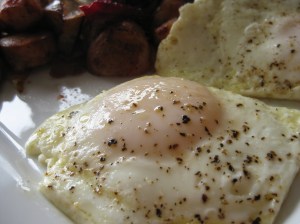
Fried Egg

Non-stick skillets are wonderful tools for frying eggs, but you still need to use a good pat of butter or a drizzle of bacon fat to be sure you get a flavorful egg that turns easily. Fried eggs with runny yolks are a breakfast classic accompanied by potatoes, hash, bacon and sausage, toast, pancakes and waffles, grits or polenta. Fried egg sandwiches were a childhood favorite and today we might go bigger and add a fried egg to a burger. We eat them on salads, pasta dishes and in soups.

Scrambled

A soft scramble of eggs just might be one of the greatest things on earth. Simply seasoned with salt and pepper and finished with a pat of butter, nothing could be more satisfying.

Scramble 1

Soft Scrambled Eggs w/ Bacon

We embellish regularly by adding grated parmagiano or cheddar cheese just as they come off the heat. They’re amazing paired with fresh sliced tomato and bacon on toasted bread. When summer time rolls around and the sweet beautiful tomatoes start rolling in from the farm, these egg, tomato and bacon sandwiches become a regular weekend meal.

Scramble 4

The versatility of the egg manifests the world over in a multiplicity of recipes showcasing this unique food. Eggs provide structure and volume to French sauces and souffles, they create elasticity and resilience in Asian and Italian egg noodles, they leaven cakes and enrich custards. Egg yolks are powerful emulsifiers that provide the backbone to mayonnaise. Still, we return to the scramble at least weekly because they never fail to satisfy in a pinch.

Tortilla

Scrambled Eggs w/ Roasted Peppers

Soft Scrambled Eggs: The Technique

We’ve learned from masters like Julia and Jacque that one never simply scrambles an egg. There’s a technique to keeping them soft and creamy and it requires carefully heating the scrambled eggs in a well oiled pan over low heat. To prevent large, lumpy curds from forming, you have to constantly stir or whisk them in the pan until they come up to temperature and form small, soft uniform curds. If you have the patience, it’s well worth taking your time with them. A 20 minute slow scramble will yield the most delicious, creamy spoonful of delicate savory custard. Take them off the heat and whisk in butter and herbs or cheese and crumbled crispy bacon.  Scrambled eggs are dense and dry when overcooked. If you go too far in cooking them, a dollop of sour cream whisked in at the end will temper the toughness and return them to a creamy consistency. Always taste for salt and serve immediately. We keep a pepper grinder, two kinds of Tabasco and a dish of large gray sea salt crystals on our table – each adds its own flavorful embellishment to the preparation.

Whatever your take on the egg, we’re sure you’ll find the following resources of interest. Be bold in your consumption of eggs. The nutritional value of this simple food far outweighs any risk from cholesterol.

American Egg Board

Incredible Edible Egg

Mayo Clinic on Dietary Cholesterol

Cheers, Steve & Jason