

A salmon poaching in a court bouillon with artichokes.
To say that it’s the best and worst of times for the Pacific salmon fishery would just be false. It’s actually the worst of times for the fish and the industry and things don’t seem to be getting much better. The reality is that most Pacific salmon fisheries are in crisis and have been for some time. Sure, you can find inexpensive salmon rather abundantly in supermarkets and at your local fish monger, but what you’re finding in the markets isn’t wild. When you’re looking for that next pink filet or steak, be sure the salmon you buy is wild Pacific fish, wild caught Alaskan salmon is best. Why wild Pacific salmon? Because most Atlantic salmon in your local grocery is farmed salmon. And farmed salmon is genetically modified, corn fed, and dyed pink with artificial color to make it look like, well, salmon. The result is a Franken fish devoid of the valuable omega-3 fats we’re learning to be so important to our health. Farmed salmon isn’t good for you and it isn’t good for our oceans. You might as well just go buy a fast food hamburger and call it a day, since it’s effects on the environment are basically analogous to the mess we call the beef industry and that factory burger will probably taste better too.
According to the Monterey Bay Aquarium Seafood Watch, wild Pacific Coho is an excellent choice for our current fish consumption. So when I saw an Andrionico’s flyer advertising flash frozen wild Pacific Coho salmon for $4.99 per pound I knew I had to have some. The first day I went over to our local Andronico’s the salmon was sold out – no surprise. When I got there the following day I was barely in time to get two large halves of the wonderfully delicate fish. The cost was just shy of $25 for the two very large pieces. A bargain for sure.
I put the fish in our deep freeze hoping to prepare one of them before the sale was over. I wanted to go back and get more of the wonderful creatures but, unfortunately, the sale only lasted a few days. It was probably best since our plans to cook the fish were postponed over and over again. When we finally got to it, we were a little overwhelmed by the task of putting it to use. We love fresh fish but we don’t cook it often. We consulted our cookbooks, scanned the recipes on Epicurious.com and scoured Martha’s site for inspiration. We ultimately settled on two basic preparations, both of which required minimal prep of the fish itself.
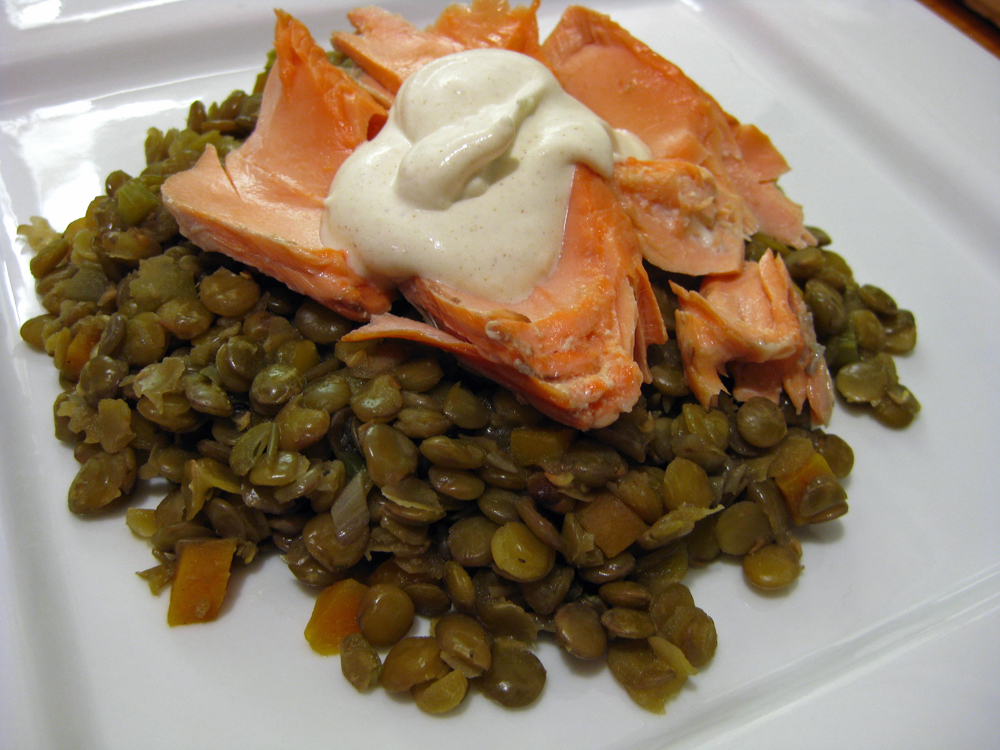
Poached salmon on top of a bed of lentils, with a dollop of dijion creme fraiche.
We poached the first piece of salmon in a savory broth containing a mix of aromatic vegetables and herbs. We roughly chopped onion, carrot and celery and tossed it into a stock pot with several cups of water. Then we added sprigs of fresh parsley and thyme, a couple of long pieces of fresh lemon zest, a couple of dried bay leaves, some pink and black peppercorns, some sea salt, and about a cup or so of white wine and brought the pot to a simmer. Meanwhile, the fish had to be scaled and rinsed. The aromatics cooked for about 20 minutes to allow all those flavors to marry. With the heat turned down to barely a simmer, the whole piece of salmon went in for a gentle poaching. It sat in the liquid for approximately 10 to 12 minutes. The result was a luscious, tender, sweet tasting fish that could be used in any number of ways. The poaching liquid We served it atop French lentils and finished with a dollop of Dijon crème fraiche. The recipe for the lentils and crème fraiche is adapted from Serious Eats: French in a Flash: Crispy Salmon with Lentils du Puy and Two-Mustard Crème Fraîche.
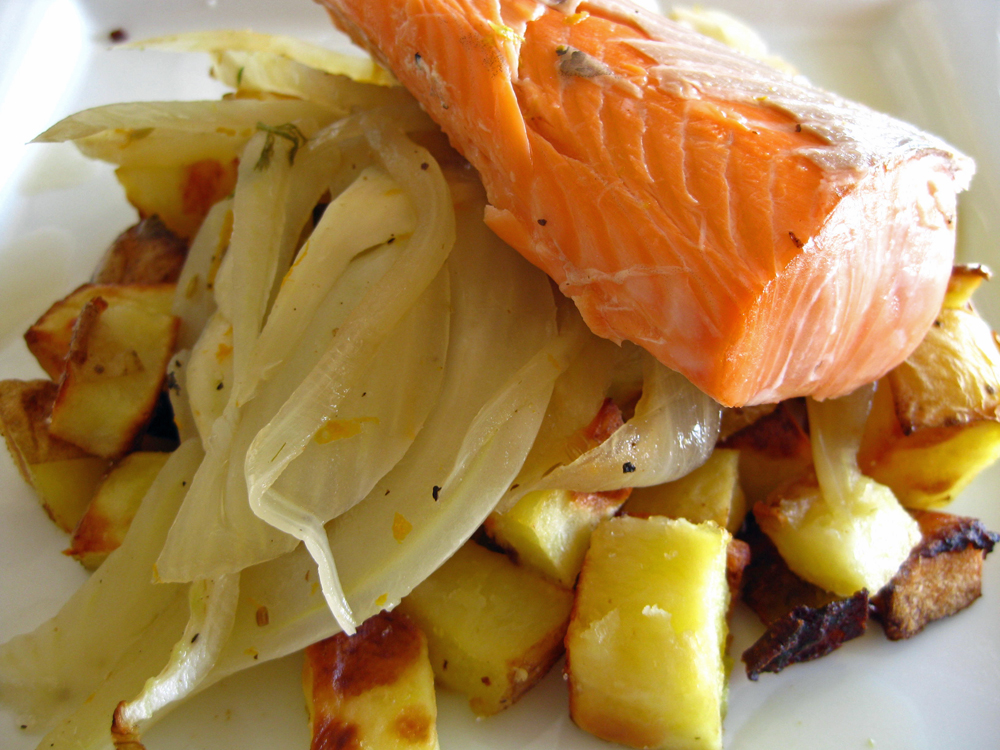
Baked salmon with fennel and orange zest, on top of roasted potatoes.
The second piece of salmon was stuffed with fresh sprigs of parsley, thyme and tarragon, then set on a bed of thinly sliced fennel and onions that had been sautéed first and finished with fennel seeds and grated orange zest. Some of the poaching liquid from the previous fish was added to the casserole dish to keep everything moist. Once prepped, it went into a 400 degree oven for approximately 10 to 12 minutes. When the fish was done, we skinned and de-boned it, and it was served with roasted potatoes and the fennel. Finished with a squeeze of lemon and fresh cracked pepper. It made for a tasty and light Sunday supper.



 (y)our food choices™