A Tale of Two Salmon: Part II

The time comes in every frozen fish’s afterlife when it must leave the security of the deep freeze to be thawed, prepped and cooked. The second large piece of Coho in our freezer met its fate this week – a fate that including a roasting, a baking and finally, a chowdering (is that a word?). Jason scaled and washed the salmon and stuffed it with fresh tarragon and lemon slices then roasted it in a 450 degree oven atop roasting fennel bulb and leeks and a dash of white wine. Roasting it bone-in with the skin on protects the meat from over-cooking. Still, salmon, like all fish, shouldn’t cook too long and get too hot or the flake of the fish becomes brittle and dry.

The resulting roast of salmon couldn’t have been tastier. We plated it with the roasted vegetables and a heap of horseradish mashed potatoes.

We wanted more the following day and since everything was cooked, all we had to do was load up a couple of baking dishes with mashed potatoes, a bit of veggies and a piece of salmon. We popped them into the toaster oven and within minutes we had a composed one dish meal. Because the salmon was dry thanks to the second cooking, it got a nice dollop of lemony mayo sauce that included chopped capers, fresh lemon juice, a dash of Tabasco and a little salt and fresh ground black pepper.


Left over Salmon

Later in the week, the leftover salmon enjoyed a second “life” in the form of a delicious chowder of sweet pink flakes in a light cream broth with potatoes, leeks and fresh herbs. I enjoyed a big bowl for lunch, then a second! The batch must have been huge because there’s plenty left for another day and Jason froze a mess of it for a future quick meal.

Cooking the salmon leaves plenty of room in the deep freeze for more fish. We’re hoping for a good catch next month when we try our hands at deep-sea fishing just off the coast of San Francisco. We’ll be sure to share the experience here so please stay tuned.

Cheers,

Steve & Jason

Roasted Salmon with Fennel and Leeks

olive oil
2 fennel bulbs, thinly sliced
1 large leek, thinly sliced
¼ white wine
½ of a whole Coho salmon or salmon steaks
bunch of tarragon
½ lemon sliced
salt and pepper

Preheat the oven to 450 degrees. Add a couple tablespoon olive oil to a small roasting pan. Add the fennel, leeks, and salt and pepper to the pan and roast for 15 minutes. While vegetables are roasting, scale and clean the salmon. Salt and pepper the cavity of the salmon then stuff with tarragon and lemon slices. Coat the fish with olive oil and add more salt and pepper. Add the white wine to the roasting vegetables, then place the salmon on top of the vegetables and roast for 15-20 minutes. Check to make sure the salmon does not over cook. Serve with mashed or roasted potatoes, and aioli, tartar sauce, or hollandaise sauce.

If you’re using salmon steaks cook them for 10 minutes, or so, depending on the thickness of them. Check often to make sure the fish does not dry out.
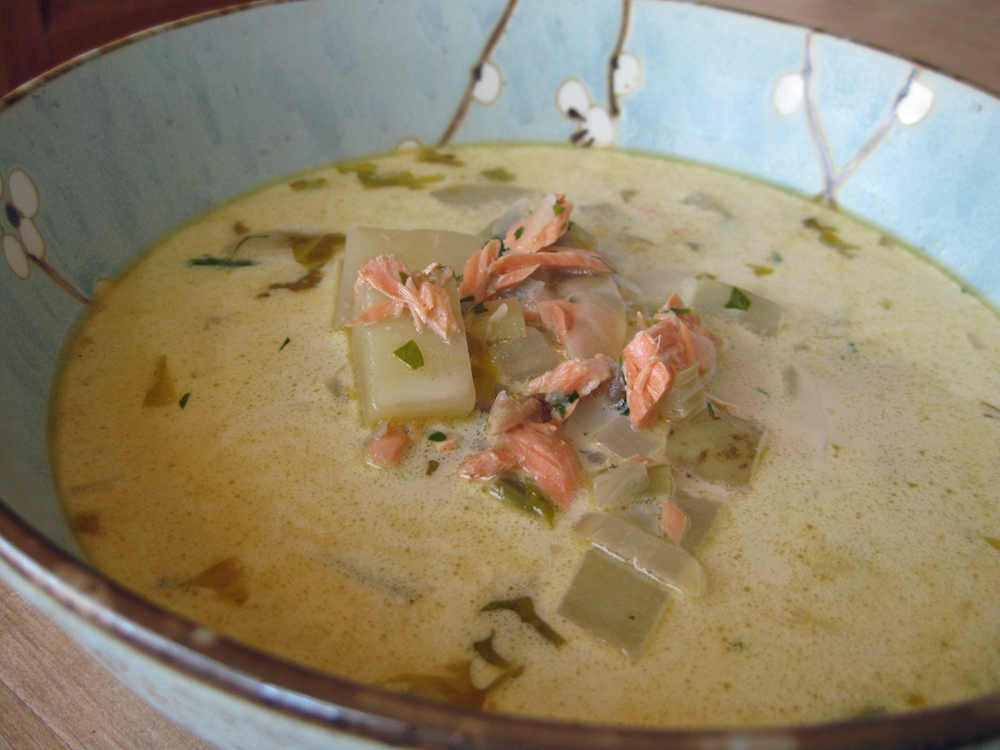
 

Salmon Chowder

Salmon Chowder

1 large onion, diced
4 stalks celery, diced
2 cloves garlic, minced
2 tbsp butter
4 cups stock (fish, chicken or veggie – we add the salmon bones to the stock to add flavor then strain before adding to the soup)
1 pint cream
1 cup milk
3 large waxy potatoes, cubed
10 oz flaked salmon
2 tbsp chopped parsley

Heat stock pot over medium heat and add butter. When butter is melted, add onions and sauté until tender and translucent, about 5 minutes. Add celery and garlic, cook for 3-5 minutes longer being careful not to brown the vegetables. Add broth and potatoes and cook for approximately 10 minutes or until the potatoes are just tender. Add salmon, cream and milk and heat until hot but not boiling. Add chopped parsley and serve.

Note: if you prefer a thicker chowder, add 2 tbsp flour to onion, celery and garlic after the sauté  and cook for a few minutes before adding stock. Be careful you don’t allow the roux to brown. Whisk liquid into the pan to prevent small “dumplings” from forming. Proceed with the remaining recipe instructions.

When Pigs Fly

Just across the river Seine on Paris’ Left Bank, we found a place filled with one restaurant after another, each with a carnival barker standing in the front door offering everything from free cocktails to deserts, wine and appetizers. A few even offered their virgin daughters. All were trying to get customers inside to eat. Those few blocks of concentrated restaurants in the Latin Quarter seemed like a traveling circus, luring people in with guarantees of delicious food and lively libations. As we walked around the quarter we come upon one restaurant we knew we needed to try. No one was outside promising us their first born, but we spotted the one thing we couldn’t refuse: inside a glass rotisserie was a small golden brown suckling pig on a spit slowly roasting and just below it, catching the little oinker’s fat and juices, were large plump chickens, also slowly roasting on a rotating spit. Each time the fat and juices of the pig and those chickens hit the bottom of the oven you could hear a sizzle and smell the wonderful combination of pig fat and crispy roasted chickens. We couldn’t resist the allure!

There were two prix fix menu options at this corner eatery. One offered a quarter of roasted chicken while the other an overly generous piece of the suckling pig. Both of the offerings were served with fries (of course), a salad, and an appetizer. Steve’s selection, the roasted pig, also came with a dessert that he was happy to share. We gorged and shared one of the richest meals of our trip. In the end, we couldn’t finish it all, but the flavors and aromas of those rich meaty dishes are permanently seared into our memories.

Upon returning home, we ventured over to Andrionico’s where we found some of the loveliest, plumpest chickens we’ve ever seen in San Francisco lying in the butcher case. They were organic, free range, local, etc. and they were on sale for $1.99 a pound! Jason’s mind immediately flew back to those chickens roasting in pig fat in Paris. How to reproduce the experience without the suckling pig, the rotisserie oven or a spit?

Jason scouted around the refrigerator for inspiration and found a ramekin of bacon fat drippings left over from some other tasty meal. We know most roast chicken recipes call for rubbing butter or olive oil on, and under, the skin of the chicken, but we haven’t heard of anyone using bacon fat in the same way. This seemed like the obvious choice given the wonderful memories of that decadent meal in Paris.

So, here’s our recipe for Parisian-style Roast Chicken, or at least our take on a Parisian roast chicken experience. We don’t think it’s anything new, but we do hope we’re starting a revival of bringing bacon fat back to the art of roasting chickens.

Parisian-style Roasted Chicken

3 large onions
1 head of garlic
4-5 large organic russet potatoes
1 4-6 lb. roasting hen (preferably free-range, organic)
1 bunch of parsley
1 small bunch of thyme
4-6 tablespoons rendered bacon fat drippings, chilled
salt and pepper

Preheat oven to 450 degrees. Peel and cut the three large onions into ¼ to 1/8  wedges, depending on the size of the onions. Peel the garlic cloves and cut the very large cloves into half or thirds. Cut the potatoes into quarter or third wedges, depending on the size of the potatoes. Reserve one onion wedge and one clove of garlic for the cavity of the bird. Toss the rest of the vegetables with salt and pepper in a medium sized roasting pan and set aside.

Rinse the chicken under cold water and dry off using paper towels. Cut off any excess fat from the bird. Rub a little bacon fat inside the cavity. Add a little salt and pepper and then the parsley and thyme, cut up the reserved onion wedge and garlic, add them to the cavity. Tie the legs of the bird together. Rub the rest of the bacon fat over the bird and under the skin of the breast. Sprinkle with more salt and pepper and place onto the reserved vegetables in the roasting pan. Grease a piece of aluminum foil, with a little bacon fat and cover the chicken. Place in the oven and roast for 20 minutes. Take the foil off the chicken and continue to roast for about and hour. If the vegetables start to brown too quickly add some white wine or chicken stock to the pan. After about 45 of roasting take the chicken out and check the temperature of the dark meat, between the leg and thigh. The chicken should register at about 180 degrees. Once the chicken is done, place on a plate and cover for 5-10 minutes. Remove the vegetables from the pan on another plate and deglaze the roasting pan with about ¼ cup of white wine or vermouth. Add about ½ to a cup of water or chicken stock and reduce a little further until a nice pan sauce is created, season with salt and pepper to taste.

Cut up the chicken and serve with the roasted vegetables and pan drippings.

P.S. We know that chickens don’t fly but we couldn’t think of a catchier title.

Bon Appetit!