Welcome to Part II in our two-part series on beef short ribs. Thanks to a very happy mistake at the grocery store (who knew flanken cut style ribs could be cut thick), we’ve had the great fortune of eating short ribs two ways this summer. If you missed it, be sure to check out our take on grilled Korean style short ribs. This time around, we’re sharing Gerald Hirigoyen‘s take on English cut short ribs .
Different cuts and thicknesses of ribs require different cooking methods. A thinner cut, like the thin Korean flanken cut, will only require a few minutes on each side, especially if cooking them over a hot charcoal grill. English or the thicker-cut flanken style ribs we highlight here, require more time. And like almost all braised meats, the ribs are better when cooked, cooled, and left for a day or two in the refrigerator. The flavors grow more complex as the meat cools and reabsorbs the juices fromt he pan. The reheated braise is rich and delicious!
Braised short ribs are fork tender. They are a terrific companion to hot, creamy polenta and a glass of Pinot Noir or Nebbiolo. Served with a refereshing romaine salad, this is a dish to enjoy at any time of year!
This slideshow requires JavaScript.
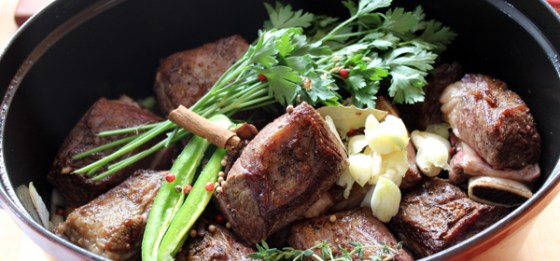
Beef Short Ribs in Moscatel
(from Pintxos by Gerald Hirigoyen as featured on the James Beard Foundation website)
2 pounds flanken-style beef short ribs, about 2 1/2 inchs thick
Kosher salt and freshly ground balck pepper
1/4 cup olive oil
1 onion, chopped
1 carrot, chopped
1 celery stalk, chopped
1 (750-ml) bottle Moscatel wine
Bouquet garni of 5 or 6 sprigs thyme, 1 bay leaf, and 6 to 8 sprigs flat-leaf parsley wrapped in a cheesecloth saceht or tied with kitchen twine
1/2 head garlic
1/2 jalepeno chile, stemmed and halved lengthwise
1 teasppon corieander seed
1 teaspoon Sichuan peppercorns
1/2 teaspoon fennel seed
1 cinnamon stick
3 star anise pods
3 whole cloves
2 cups chicken stock, or as needed to almost cover
2 tablespoons Moscatel vinegar
Chopped fresh flat-leaf parsley for garnish
Preheat the oven to 350ºF.
Cut the ribs between the bones so you have individual pieces. Season them on both sides with salt and pepper. Add the olive oil to a large casserole or Dutch oven, and heat over high heat until it ripples. Add the ribs to the casserole and to brown them on all sides, about 3 to 4 minutes a side. Transfer to a plate.
Decrease the heat to medium, add the onions, carrots, and celery, and cook, stirring frequently, for 2 to 3 minutes, or until lightly browned. Return the ribs to the casserole and add the wine, thyme, rosemary, sage, garlic, chile, coriander seed, Sichuan peppercorns, fennel seed, star anise, cloves, and cinnamon stick. Increase the heat to high, bring to a boil, and cook for about 6 minutes, or until the liquid is reduced by half. Add the stock and bring to a boil. Cover and place in the oven for 1 to 1 1/2 hours, or until the meat is fork-tender.
Transfer the ribs to a plate. Strain the liquid through a sieve into a large bowl. You should have about 4 cups. Let sit for about 20 minutes, or until the fat rises to the surface. (You can also refrigerate the liquid for a few hours so the fat congeals on the surface, making it easier to remove.) Skim off the fat and discard it. Pour the defatted liquid into a saucepan, place over high heat, bring to a boil, and cook for about 12 minutes, or until reduced to 1 cup. Remove from the heat and add the vinegar. (The ribs can be returned to the liquid, cooled, covered and refrigerated for up to 2 days before continuing. The flavor of the dish will improve during this rest period.)
To serve, reheat the ribs in the sauce in the oven until warmed through. Taste the sauce and add another splash of vinegar and some salt and pepper if needed. Arrange the ribs on a plate and pour the sauce over the top. Garnish with parsley.
Creamy Polenta
3 cups water
1 cup whole milk
1 bay leaf
1 sprig of thyme
1 cup polenta
1/2 teaspoon salt
1/4-1/2 cup shredded Parmigiano Reggiano
2 tablespoons unsalted butter
salt and pepper
Bring to boil over medium heat in a medium sized pan the water and milk with the bay leaf and thyme. Gradually whisk in the polenta and salt and cook until thickened, approxiamely 15-20 minutes. More water may be added if polenta becomes too thick too soon. Once fully cooked, take the polenta off the heat and add the cheese and butter. Whisk until fully incorporated. Season with salt and pepper. Serve immediately.




 (y)our food choices™