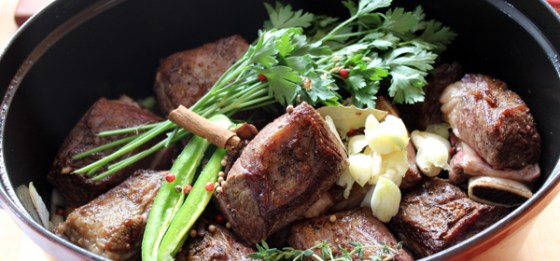
Beef Short Ribs with Creamy Polenta

Welcome to Part II in our two-part series on beef short ribs. Thanks to a very happy mistake at the grocery store (who knew flanken cut style ribs could be cut thick), we’ve had the great fortune of eating short ribs two ways this summer. If you missed it, be sure to check out our take on grilled Korean style short ribs. This time around, we’re sharing Gerald Hirigoyen‘s take on English cut short ribs .

Different cuts and thicknesses of ribs require different cooking methods. A thinner cut, like the thin Korean flanken cut, will only require a few minutes on each side, especially if cooking them over a hot charcoal grill. English or the thicker-cut flanken style ribs we highlight here, require more time. And like almost all braised meats, the ribs are better when cooked, cooled, and left for a day or two in the refrigerator. The flavors grow more complex as the meat cools and reabsorbs the juices fromt he pan. The reheated braise is rich and delicious!

Braised short ribs are fork tender. They are a terrific companion to hot, creamy polenta and a glass of Pinot Noir or Nebbiolo. Served with a refereshing romaine salad, this is a dish to enjoy at any time of year!

This slideshow requires JavaScript.

Beef Short Ribs in Moscatel
(from Pintxos by Gerald Hirigoyen as featured on the James Beard Foundation website)

2 pounds flanken-style beef short ribs, about 2 1/2 inchs thick
Kosher salt and freshly ground balck pepper
1/4 cup olive oil
1 onion, chopped
1 carrot, chopped
1 celery stalk, chopped
1 (750-ml) bottle Moscatel wine
Bouquet garni of 5 or 6 sprigs thyme, 1 bay leaf, and 6 to 8 sprigs flat-leaf parsley wrapped in a cheesecloth saceht or tied with kitchen twine
1/2 head garlic
1/2 jalepeno chile, stemmed and halved lengthwise
1 teasppon corieander seed
1 teaspoon Sichuan peppercorns
1/2 teaspoon fennel seed
1 cinnamon stick
3 star anise pods
3 whole cloves
2 cups chicken stock, or as needed to almost cover
2 tablespoons Moscatel vinegar
Chopped fresh flat-leaf parsley for garnish

Preheat the oven to 350ºF.

Cut the ribs between the bones so you have individual pieces. Season them on both sides with salt and pepper. Add the olive oil to a large casserole or Dutch oven, and heat over high heat until it ripples. Add the ribs to the casserole and to brown them on all sides, about 3 to 4 minutes a side. Transfer to a plate.

Decrease the heat to medium, add the onions, carrots, and celery, and cook, stirring frequently, for 2 to 3 minutes, or until lightly browned. Return the ribs to the casserole and add the wine, thyme, rosemary, sage, garlic, chile, coriander seed, Sichuan peppercorns, fennel seed, star anise, cloves, and cinnamon stick. Increase the heat to high, bring to a boil, and cook for about 6 minutes, or until the liquid is reduced by half. Add the stock and bring to a boil. Cover and place in the oven for 1 to 1 1/2 hours, or until the meat is fork-tender.

Transfer the ribs to a plate. Strain the liquid through a sieve into a large bowl. You should have about 4 cups. Let sit for about 20 minutes, or until the fat rises to the surface. (You can also refrigerate the liquid for a few hours so the fat congeals on the surface, making it easier to remove.) Skim off the fat and discard it. Pour the defatted liquid into a saucepan, place over high heat, bring to a boil, and cook for about 12 minutes, or until reduced to 1 cup. Remove from the heat and add the vinegar. (The ribs can be returned to the liquid, cooled, covered and refrigerated for up to 2 days before continuing. The flavor of the dish will improve during this rest period.)

To serve, reheat the ribs in the sauce in the oven until warmed through. Taste the sauce and add another splash of vinegar and some salt and pepper if needed. Arrange the ribs on a plate and pour the sauce over the top. Garnish with parsley.

Creamy Polenta

3 cups water
1 cup whole milk
1 bay leaf
1 sprig of thyme
1 cup polenta
1/2 teaspoon salt
1/4-1/2 cup shredded Parmigiano Reggiano
2 tablespoons unsalted butter
salt and pepper

Bring to boil over medium heat in a medium sized pan the water and milk with the bay leaf and thyme. Gradually whisk in the polenta and salt and cook until thickened, approxiamely 15-20 minutes. More water may be added if polenta becomes too thick too soon. Once fully cooked, take the polenta off the heat and add the cheese and butter. Whisk until fully incorporated. Season with salt and pepper. Serve immediately.

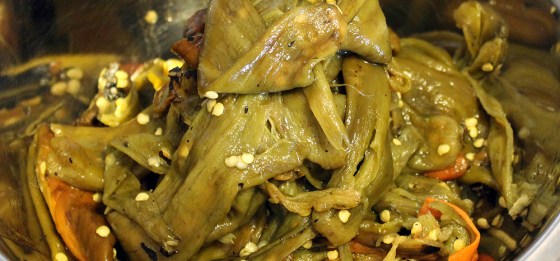
New Mexico Green Chili: Green Chili and Wild Antelope Pozole

Our dear friend, and artist extraordinaire, Zannah Noe, gifted us a giant bag of frozen, roasted New Mexico green chilies, a souvenir of her 2012 Albuquerque painting stint. After sampling Zannah’s version of pozole during one of her early returns to SF, we were excited to have our own chilies on hand for a host of chili-accented dishes.

New Mexico green chilies are quintessential southwest food. Native chilies have been cultivated in the region for nearly 6,000 years. They’re full of vitamins – including tons of vitamin C – and the capsaicin (the stuff that makes them hot) has a number of medicinal uses. In fact, the evidence of capsaicin’s healthfulness is overwhelming and those who avoid hot chilies because of “stomach issues” do so to their detriment.  The capsaicin in chili peppers seems to have a protective effect on the stomach lining and may reduce the risk of heart disease and diabetes. Contrary to popular misconceptions, peppers do not cause stomach ulcers. In fact, the chemicals in green chili aid in the prevention of diverticulitis, a nasty inflammation of the intestinal tract. Folks who suffer from heartburn often blame recently consumed peppers for the upset, but the real causes of an over acidic stomach have nothing to do with “spicy foods” and far more to do with poor diet. The bottom line: hot peppers are good for the stomach!

We finally busted out our frozen bag of flavor-packed peppers for this truly western stew. Pozole has an ancient, pre-Columbian origin and early versions of the dish were eaten ritualistically by early Americans; shared by entire communities, after sacrifices to the gods. In this version, we substitute traditional pork with wild antelope for a more flavorful, leaner stew. The pressure cooker makes quick work of rehydrating the hominy and tenderizing the wild meat. Served with warm corn tortillas, diced fresh radishes and cilantro, a bowl of green chili pozole is the perfect mid-winter warmer.

References

New Mexico Chili Association

The Chili Pepper Institute – New Mexico State University

Food as MedicineDharma Singh Khalsa, M.D.

This slideshow requires JavaScript.

Recipe

Green Chili and Antelope Pozole

1 cup dried hominy, or 2 cans cooked hominy, drained
1 1/2 pounds antelope stew meat, or other venison (pork or beef can be substituted), cut into one inch pieces
2 – 3 tablespoons olive oil
1 large onion, diced
2 teaspoons dried oregano
2 teaspoons dried cumin powder
1 bottle beer
4-6 cups chicken broth, water, or a mixture of both
1/2 – 1 cup, or more, pureed roasted New Mexico green chilies or canned chilies*
salt and pepper

Toppings:

queso fresco
diced avocado
sliced radishes
lime wedges
chopped cabbage
chopped cilantro

Special Equipment: pressure cooker

If using dried hominy; place the dried hominy on a baking sheet and search, picking out any small stones or other items. Rinse the hominy in a colander then place it in the pressure cooker. Cover with water at least three inches above the hominy and add 1 tablespoon salt, cover and heat over medium high until the water comes to a boil. Place the lid on the pressure cooker and cook for 30 minutes. Release the pressure using the cold water method. Remove the lid and check the hominy for doneness. If more time is needed cook in 10-minute intervals until the hominy is chewy but still firm. Do not over cook it at this point. The hominy will need to cook a little longer with the meat. Once the hominy is cooked, drain the liquid and set the hominy aside.

Dry the inside of the pressure cooker before continuing. Place the pressure cooker over medium heat and add olive oil. When the oil is shimmering, add pieces of the antelope to the pan. Do not over crowd the pan or the meat will steam instead of brown. Cook the antelope until well browned on each side, 3-5 minutes, remove from the pan and place on a plate, set aside. Continue to cook all the meat. Once all the meat is cooked and removed from the pan add more olive oil, if needed, and the diced onion. Cook for 4-6 minutes until translucent, scraping the pan often to avoid burning. Return the meat to the pan and add the oregano, cumin and other spices. Using a micro-planer, grate the garlic over the meat and onion. Cook for 20 seconds then add the bottle of beer, scraping up the brown bits.

Return the hominy to the pan and add the chicken stock, or water, making sure you have enough to cover the meat and hominy by about 2 inches. Add the pureed green chili, starting with 1/2 cup than add more if desired, 1/4 to 1/2 cup at a time, up to 1 1/2 cups. Season with salt and pepper. Bring the broth to a boil then cover with the lid. Cook at low pressure for 20-30 minutes. Cool using the cold water method and check the meat for tenderness. If needed, cook the stew in 10 minute intervals until the meat is tender. The meat will tenderize if allowed to be cooked the day before and then reheated or cooked earlier in the day and allowed to rest before reheating and serving.

Serve with crumbled queso fresco, chopped avocado, slices of radishes, chopped cabbage, chopped cilantro, and wedges of lime to squeeze over the top.

*Some farmer’s markets sell roasted peppers or chilies. If you have one in your area, these fresh roasted chilies are much better than the canned varieties. However, in a pinch, you can always use the canned ones. Also, all chilies are not created equal. Some have more heat then others. Use caution when adding them to your pozole.