Whisky: It’s What’s For Dinner

They're rare so get them while you can!

We’re likely to make whisky dinners a habit after a recent event presented by Whiskies of the World and The City Club Whisky Society in San Francisco. City Club’s David Forsyth and WoW’s Douglas Smith hosted Ed Kohl of ImpEx Beverages who led the evening’s educational tasting of a magnificent selection of whiskies from the Ian Macleod DistillersChieftain’s Range of single cask bottlings.

Now, you might be thinking to yourselves, “Whisky with dinner? That’s just crazy!” Believe us, whisky is a fantastic companion to many of your favorite foods. Pairing food and spirits takes some experience, but you already know that it works well with examples like tequila and carne asada or Grand Marnier and chocolate soufflé.
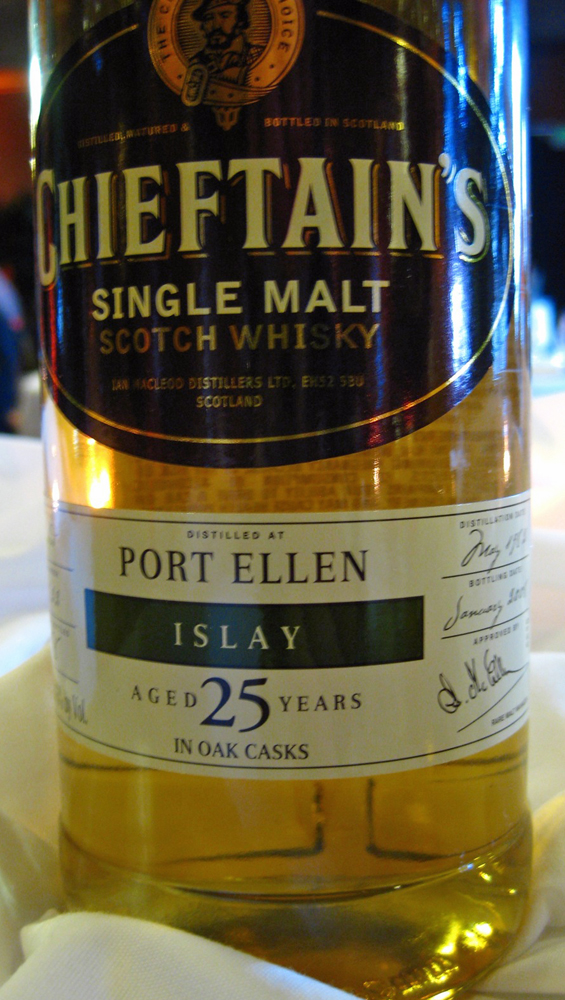
This was our favorite-and most rare-of the bunch.

So, here’s the setup: each course of the meal is paired with two different but complimentary Scotch whiskies, each selected for its unique flavor profile and likely affinity to the flavors of the food it accompanies. As the meal progresses, our whisky expert explains the whisky making process while describing the flavors of the whiskies in front of us on the table. Diners have a unique opportunity to experiment with pairings that would never have occurred to them (who thinks to serve whisky with fish?) while learning quite a lot about a spirit category many Americans are rediscovering.

The City Club’s very own Chef Michael Munoz, formerly of Moose’s Restaurant in North Beach, put out a fantastic meal that began with a taste of pepper seared beef tenderloin, roasted peppers and blue cheese cream on toasted crostini. Our whisky experts from ImpEx paired the hors d’oeuvres with two fantastic drams – the first, an 8 year old Isle of Skye blended malt with its mellow smokiness, was the perfect start to the evening’s tasting; the second, a 31 year old bottling of Speyside malt Allt a’ Bhainne, was a spicy, warm and woody counterpoint to the rich flavors of the beef and blue cheese.

Beautiful and delicious scallop with duck hash.

The pan seared Maine Diver Scallop dish that kicked off the sit down meal impressed us. Chef Munoz plated these beautiful scallops with Muscovy Duck Sausage Hash, Rocket greens and a delicate sauce béarnaise. The accompanying whiskies, an 18 year old Glen Moray from Speyside and a 25 year old Port Ellen from Islay were gorgeous on their own. The exquisite Port Ellen was jaw droppingly delicious and oh so fine! The Glen Moray was full of fruit and sweet oaky spice that lingered for a very long time. Both complimented the scallop and duck perfectly.

Venison, the other red meat.

Our venison consumption has been limited to the wild variety – mule deer, elk and antelope from Idaho and Wyoming – so we were curious to taste Chef’s Denver Leg of Venison, which he plated with herbed spaetzle, a puree of English peas, an heirloom tomato sauce and black truffle jus. We were impressed by the kitchen’s expert touch with the venison, served nice and rare. Venison is naturally lean relative to beef and as such doesn’t hold up well to overcooking. Wild venison cooked well turns into shoe leather and once “ruined” must be cooked for a very long time to get it back to a point where it is chewable. This dish was delicate and perfectly tender! We loved the spaetzle, a treat we’ve prepared at home with good success but something we don’t eat often enough. If there was a disappointment in the dish, it had to be the pea puree. It wasn’t a bad idea, but it didn’t do anything for the venison and one of us thought it tasted as though the peas were old. We both agreed that while some preparations of greens might pair well with whisky, this pea puree did not. The flavor of the tomato sauce was barely perceptible. The course was paired with a 16 year old Linkwood, a Speyside malt of excellent character with sweet smoke and spicy cedar notes that worked beautifully with the venison. We also tasted a 14 year old Glenrothes that has been finished in a Burgundy cask (also from Speyside). We love Glenrothes whisky, and this one was fine, but the Burgundy finish was distracting and, for a few dinner guests we spoke to, confusing. They wanted wine with their venison and the Glenrothes disappointed because the wine finish is, of course, very subtle.
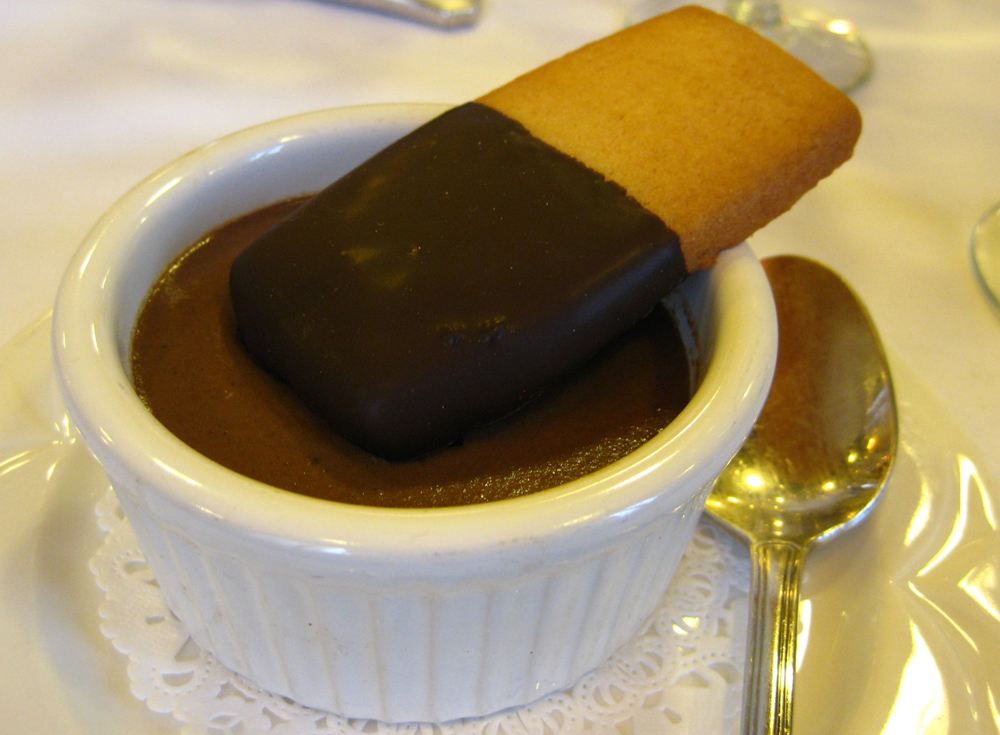
You can never go wrong with Chocolate and Whisky.

The evening meal ended with a dark chocolate pot de crème and chocolate dipped hazelnut short bread. The pot de crème was interesting – very buttery and dense. We thought it was delicious. The hazelnut short bread was awesome! Unlike many shortbreads, this one was crisp not sandy. We wanted a plate of them. Desert paired nicely with an 11 year old Madeira finished Dalmore that we thought to be perfectly sweet and creamy with just hint of chocolate and smoke. It’s a warm, sunny malt from the Scottish Highlands that works nicely with the added richness of the Madeira.

Our compliments to the Chef and the whisky makers! You’ve inspired us to think more broadly about food and beverage pairings. To those of you who are still scratching your heads, we say let go of your inhibitions and give it a try. How bad can a great steak paired with a great glass of Scotch taste? We think you’ll love them together.

First, We Make Manhattans…

Toss out the toxic red cherries. Home canned Maraschino cherries make the perfect cocktail garnish.

We love cocktails! There’s nothing better than a frosty glass with 2-3 ounces of a shaken potion to celebrate the beginning of the weekend, or just the end of a workday. Bourbon, the sweet brown all American elixir, makes wonderful concoctions that will turn any vodka drinker into a whisky fan after their first sip.

Depending on the origin of the brew, whisky is spelled with or without the “e”  – as in “whisky” or “whiskey.” American whiskey includes that “e” but that isn’t the only difference between it and it’s counterparts across the Atlantic. American whiskies tend to be sweet by Scottish standards. Most are made from a mix of corn, rye and wheat and aged in oak barrels, though the time a particular whiskey spends on oak will vary from bottling to bottling. Of course, there are differences in the malting and distillation processes – the use of peat fired drying kilns and the smoke flavor it imparts to Scottish whisky comes to mind – differences that result in delicate nuances that make one whiskey best served neat, while another one may be mixed to make an ice cold cocktail and served up. While we could go into far more detail about the differences between whisky styles, and the whiskey making process, this post is about cocktails.  More specifically, this post is about our holy trinity of whisky cocktails: Manhattans, Sazaracs, and Rob Roys.

I love a cocktail...

Manhattan

Makes one and can be doubled.

Our favorite bourbons for this cocktail are Bulleit, Woodford’s Reserve, and Maker’s Mark, in that particular order. What makes the best Manhattan, aside from the one of the great bourbons mentioned, is the use of our own homemade maraschino cherries. We no longer buy those toxic red ones – they should be banned! It’s easy enough to make your own with a good bottle of Luxardo’s Maraschino Liqueur and some fresh seasonal cherries. Spring is the perfect time to can a few jars of them to keep year round. All you need to do is pit the cherries, add them to a sterilized mason jar (leaving enough space at the top so it’s not overfilled), pour in the maraschino liqueur and process in a water bath. You can also make a simple jar that will last a month or two in the back of your fridge. Pit the cherries add the maraschino liqueur and refrigerate for a day or two before using.

2 ounces Bourbon

½ ounce Sweet vermouth,

Dash or two Angostura Bitters

Homemade Maraschino cherry

A half hour before making the cocktail put the cocktail glasses in the freezer. Fill a cocktail shaker half way with ice. Add the bourbon, sweet vermouth, and bitters. Shake gently until the cocktail shaker becomes frosty. Place a maraschino cherry and 1/2 teaspoon of Maraschino liquor in the bottom of a chilled cocktail glass. Strain the drink into the glass and enjoy!

Sazerac

two at the most...

Makes one but can be doubled. If doubling, mix each drink separately.

We love this classic New Orleans cocktail! Our first experience of the drink came at the hands of the masters at Alembic and we’ve been hooked ever since. We regularly use bourbon in our sazerac recipe, but purists will tell you that this is a drink best made from pure rye whiskey. We’ve tried it with Wild Turkey’s 101 proof Straight Rye with great success. We’ve alternately coated the cocktail glass with absinthe and green chartreuse and like them both. The absinthe adds a spicy sweetness to the finished cocktail. The chartreuse is herbaceous and bitter making the cocktail slightly more complex but with a clean finish. The “official” recipe for the sazerac is an historical mystery, but most agree that the original sazerac was a cognac-based cocktail. The absinthe or pastis came later as did the Peychaud’s Bitters most believe to be a necessary ingredient. When you do your research on the sazerac (and we know you will) you’ll find far too many opinions on what is and isn’t the right way to make the drink. Grain of salt, people! Stick to the basics but experiment where you want. For example, we’ve abandoned the Peychaud’s because we don’t like them – they’re artificially colored and they lack complexity – opting instead for good old Angostura bitters. But what do we know?

2 ounces Bourbon or Rye

1 tsp sugar

Several dashes of angostura bitters

A dash of Absinthe or enough to coat the bottom and sides of the cocktail glass without dripping out

Lemon twist

Note: This is a labor intensive cocktail that requires a little planning. It’s worth every second it takes to prepare!

Set serving class in freezer to chill. In a rocks glass, add sugar and bitters and stir until sugar begins to dissolve. Add bourbon or rye and muddle them until the sugar is completely dissolved (this takes time). Remove cocktail glass from freezer and add absinthe, turning glass on its side to coat the bottom and inside of the glass. To the bourbon sugar bitters mixture, add 2 or 3 ice cubes and stir until chilled. Strain into frozen cocktail glasses. Garnish with lemon twist using a citrus zester. Be sure to remove the twist of lemon peel over the surface of the cocktail so that the oils from the zest “spritz” over the top of the drink. Serve!

Rob Roy

after three I'm under the table, and four I'm under the host.

Oh, to mix Scotch with anything other than a little water. Alas, there are several classic Scotch-based cocktails and we’re not entirely averse to pouring some Johnnie Walker Red or Black label over ice and then adulterating it with any number of mixers. With this cocktail you’ll use Scotch whisky and we recommend Johnnie Walker Red, sometimes Black, but never Gold, Green, or Blue, and don’t even think about adulterating a single malt Scotch with vermouth and bitters! If God doesn’t strike you down for such a grave transgression, a Scotsman surely will! Traditionally, the Rob Roy is served “sweet” hence the use of sweet vermouth. But the cocktail may be made “dry” by substituting dry vermouth for the sweet. The “perfect” Rob Roy uses equal parts of both!

2 ounces Johnny Walker Red or Black Label Blended Scotch

1 ounce Sweet (or Dry) Vermouth (half an ounce of each for a “perfect” Rob Roy)

Dash of Angostura Bitters

Add ingredients to an ice-filled cocktail shaker and shake until the shaker turns icy. Serve up in a cocktail glass with a cherry (or lemon twist if using dry vermouth).

Cheers, Jason and Steve -hic