

I always imagined baking bread to be one of those quintessentially old-fashioned home economics throwbacks to a quainter time when women rose before dawn to build the oven fires then got to work on building a good loaf for the day’s meals. It’s a rare home in this country where the warm yeasty smells of oven backed bread draw the home’s residents to the family hearth. After many years of cooking together J. has finally found the bread recipe to beat all bread recipes for those of us who still believe we’re too busy to bake bread.
Always on the lookout for a genius adaptation, J. found this recipe on an America’s Test Kitchen pod-cast! Theirs is a take on Mark Bittman’s “No-Kneed Bread” recipe published in his blog on the The New York Times online edition back in October of ‘08. We’ve replaced our regular store purchases with the home made stuff. To my surprise, I’ve memorized the recipe and technique and feel very confident in my experimentations. Once you’ve tried this simple, delicious recipe, you’ll know what we’re talking about.
We eat the bread we bake daily. It’s an essential ingredient in the many sandwiches that are our weekday lunches. It is the foundation of every savory weekend breakfast – eggs, tomatoes, bacon. It sits toasted on the side of our salad plates. It floats atop soups. Soaked in water it provides body to gazpacho. Cubed, oiled and tossed with garlic before toasting, it becomes a flavorful crunch to Ceasar’s Salad. These loaves constitute our daily bread, a source of nutrients that is now foundational in our diet.
We can hear you asking, “But why should I bother when I can get perfectly delicious baked bread from the bakery in my neighborhood (if you’re lucky enough to live where these things exist), or from Whole Foods, or …?” Let us offer the following as a short list of reasons why you should attempt to do this at home:
- You prove to yourself that you can feed yourself well;
- You get to enjoy the aromas of freshly baked bread in your own home (I have one in the oven as I type and I can tell you it smells like heaven);
- You get to enjoy fresh baked bread made from ingredients that cost you a fraction of what you’d pay for an artisanal loaf from the local shop;
- You get to control what goes into your bread AND you get to experiment with those ingredients;
- You get to show off to your friends, family and coworkers who will be genuinely mesmerized by the effort.
If you can find locally grown and milled organic flours, buy them. We need to support local farmers more than ever and every loaf counts. We use Giusto’s organic flours in our breads. This San Francisco company sources its grains from growers throughout the U.S. and Canada. We’re still on the hunt for well-made Northern California grown and milled flours. If you have any recommendations, please let us know.
Cheers, Steve & Jason
Bread
This may be the easiest bread recipe ever. Experiment with the flours. We haven’t had a miss yet!
15 ounces of flour. We use a mix of all purpose, whole wheat and/or bread flour. We’ve also experimented with quinoa and oat flours. Typically, we’ll use 10 ounces of all purpose or bread flour and 5 ounces of another flour.
1/4 tsp. Quick yeast
11/2 tsp. Sea salt
That’s it for dry ingredients. Be sure to whisk them together to evenly distribute yeast and salt throughout the flour before adding the liquid ingredients.
7 oz. Water
3 oz. Beer This ingredient gives you another chance to experiment. A simple American lager will do, but you may try something with more bite or you might try using a sweet wheat beer. We’ve used hard cider and the loaf turned out perfectly.)
1 tbs. Distilled vinegar
Those are the wet ingredients. Measure them all into a single container before adding them to the dry ingredients. Now, for the “hard” part. Make a little well in your bowl of flour mixture. Pour wet ingredients into well. Mix all ingredients together with a spoon or rubber spatula until just combined. Cover the bowl with plastic and set it aside. Don’t touch it. Don’t think about it. Just walk away. Seriously, that’s it. You don’t have sore shoulders from kneading the dough (I know, many of you love kneading bread and we support you totally!) and you don’t have a big mess to clean. Simple ingredients, simple mixing technique – now what? Wait 12 to 18 hours.
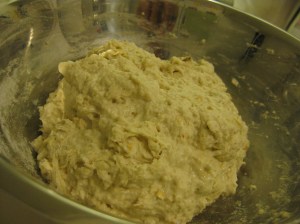
Just Mixed
After all those hours of no activity, you get to revisit the dough for one last bit of work. Flour a surface and turn the spongy dough out for a very quick kneading. Wait, didn’t we say you didn’t knead this bread? We did, but we didn’t really mean it. But here’s the deal, you only have to knead the dough 10 times. That’s it. It’ takes seconds and the dough is so soft you won’t want to stop, but you must. Once kneaded, the ball of dough is placed on a generous piece of parchment paper that has been lightly oiled and set in a large skillet. Believe us, we really mean a skillet. Now, cover the beautifully shaped round dough with a piece of plastic and let it proof for a short 2 hours.
The really interesting part of the recipe comes next.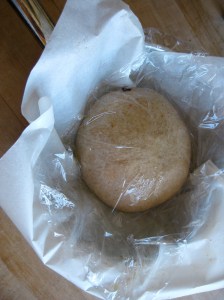
After the dough has rested and risen another hour and a half, turn your oven on to 500 degrees and place a dutch oven or heavy stock pot with its lid right into the oven to warm up. Over the next 30 minutes, your oven will come to temperature and so will that pot. It needs to be oven hot for this next step. Once the oven and pot are blazing hot, uncover the dough, dust the top with a little flour and score the top to allow it to expand during baking. Now, take the pot out of the oven, being very careful not to touch any part of it. Remove the lid and set it aside (don’t forget, it’s very hot and you’re going to have to put it back on the pot so place an oven mitt or towel on the handle so you don’t burn yourself when you grab for it).

setting it into the pot …
Next, using the parchment as a sling, lift the bread up out of the skillet and gently lower it into the hot pot, parchment and all. Cover it back up with the hot pot lid and set the pot back into the oven. Lower the temperature of the oven to 425 and bake the loaf, covered, for 30 minutes. At the end of those 30 minutes, remove the lid from the pot and continue to cook the loaf for another 20-30 minutes.
When it’s done, the bread should be nicely brown and hollow sounding when you thump the bottom crust with a finger. Set it on a rack to cool. You’re done!

Cool-ing!
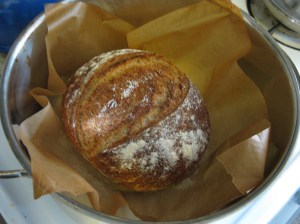
All Done!


 (y)our food choices™